Why Healthcare Providers Go Looking for a New IT Provider
Ontario healthcare providers aren’t searching for IT support because they want better Wi-Fi. They’re searching because something specific went wrong. An EMR migration stalled and 3 staff members can’t open patient records. A cyber insurance renewal came back with 30 questions about encryption, access controls, and incident response that nobody in the practice can answer. A hospital partner sent a vendor security assessment, and it became clear the clinic’s IT setup won’t hold up.
That’s who this list is for: 5 IT providers, ranked on what matters when the buying decision is driven by PHIPA compliance, EMR reliability, or cybersecurity pressure from insurers and partners. ACT360’s IT services for healthcare providers are one of the 5, and it’s a disclosed conflict that we rank first. If you’re after general IT support rather than healthcare-specific capability, see our ranking of the best managed IT companies in Barrie and our other city rankings across Central and Southern Ontario.
I’m Jeffrey Bowles, Partner and Director of IT Services at ACT360. I’ve worked with healthcare practices on PHIPA requirements, EMR transitions, and cybersecurity planning, and this ranking reflects that vantage point. All provider data was sourced from publicly available information in November 2026.
How We Evaluated These Providers
Healthcare IT buying decisions come down to 4 things. We ranked on all 4. This is an editorial ranking, not a weighted scoring model: the criteria informed the judgment, the judgment is ours, and ACT360 produced this list.
| Criterion | What we looked at | Why it matters |
|---|---|---|
| PHIPA compliance depth | Whether the provider publishes specific PHIPA-aligned processes (written agent agreements, safeguards, breach response) or just lists compliance as a bullet point | PHIPA requires documented evidence that safeguards exist and that your IT provider acts as your agent under a written agreement |
| EMR system support | Support for named Ontario EMR platforms (Accuro, OSCAR, PS Suite, TELUS CHR, AbelMED, PointClickCare) and coordination with EMR vendors | When the EMR goes down, patient care stalls |
| Healthcare cybersecurity | Managed detection and response, endpoint protection, phishing defense, and security awareness training for clinical staff | Health records are a high-value target because, unlike a credit card, they can’t be cancelled and reissued |
| Ontario healthcare experience | Documented healthcare client relationships and an understanding of clinical workflows | Downtime during patient hours costs more than downtime after 5 PM, and network changes can break EMR integrations |
IT Support Providers for Healthcare at a Glance
A side-by-side view before the full breakdown.
| Provider | Best for | PHIPA approach | EMR support | Reviews | HQ | Published pricing |
|---|---|---|---|---|---|---|
| ACT360 | One team for IT, security, and applications | Compliance built into the ACTION methodology | Vendor coordination model | 4.5 from 44 Google reviews | Barrie | $65 to $180 per user per month (Managed IT) |
| BlueBird iT | Healthcare-only, national scale | Compliance portal and healthcare-only practice | TELUS Health field service provider | No review count verified | Toronto | Not published |
| OITC | Deepest documented compliance | Written custodian/agent agreements, Canadian data residency | Accuro, OSCAR, PS Suite, AbelMED, PointClickCare, Kroll, TELUS CHR | About 4.8 from 13 Google reviews (third-party listing) | Burlington | Not published |
| Compudata | Practices in London and southwestern Ontario | PHIPA and PIPEDA guidance | General EMR adoption support | No review count verified | London | Not published |
| Medibyte | Eastern Ontario clinics | PHIPA-aware, audit-ready setup | OSCAR, PS Suite, Accuro, Wolf, TELUS CHR | No review count verified | Perth | Flat monthly rate (amount not published) |
Here’s the full breakdown, with the strengths and the honest gaps for each.
The 5 Best IT Support Options for Healthcare Providers in Ontario
1. ACT360: Healthcare IT Support Built on a Full Technology Partnership

Practices that hire one company for IT support, another for cybersecurity, and a third for the website end up managing 3 vendor relationships and hoping they talk to each other. They usually don’t.
ACT360’s healthcare work starts from the other direction. Healthcare IT support isn’t sold as an isolated service. It sits on top of a managed technology partnership where the team already knows the practice’s environment, workflows, staff, and goals, and cybersecurity for healthcare practices, PHIPA compliance documentation, web presence, and internal applications all come from the same team.
The ACTION methodology (Assess, Comprehend, Tailor, Implement, Optimize, Nurture) means security and compliance recommendations come from firsthand knowledge of how the practice operates, not just a network scan. A family health team running Accuro across 3 locations with a part-time receptionist handling admin has different exposure than a dental practice with 6 chairs and a digital X-ray workflow. ACT360 builds the security program around the actual practice, not a template.
The 90-day exit clause on Managed IT agreements backs that up. There’s no multi-year lock-in. The relationship holds because the team knows the practice’s configuration, compliance posture, and staff workflows.
The honest limitation. ACT360 is headquartered in Barrie and serves Central and Southern Ontario. Practices in Ottawa, Kingston, or Northern Ontario won’t get the on-site response of a local provider. Healthcare is also one vertical among several for ACT360, alongside manufacturing, engineering, and others, while BlueBird iT works only in healthcare.
Pricing. Managed IT runs $65 to $180 CAD per user per month. The upper end covers full management, including managed security, on-site support and custom application support. Most organizations we support land between $80 and $100 per user, which for a 20-seat clinic is roughly $19,200 to $24,000 a year. See what IT support costs for healthcare providers for more detail.
Best for Ontario healthcare practices that want one partner handling IT support, cybersecurity, compliance, web, and internal applications, with a compliance program built by a team that understands the practice’s operations.
2. BlueBird iT: The Healthcare-Only IT Provider
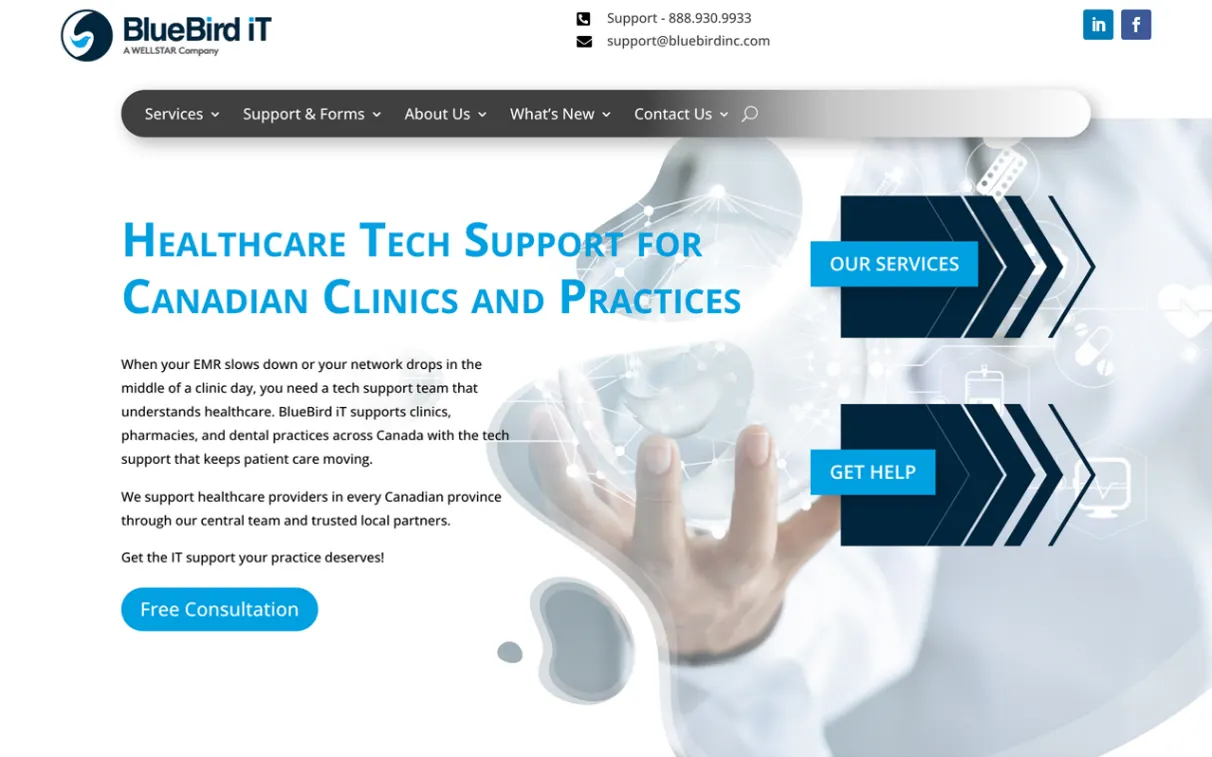
BlueBird iT has built its business around one vertical: healthcare. Based in Toronto, it describes itself as the first MSP to focus exclusively on the medical sector, and supports clinics, pharmacies, dental practices, and nurse practitioner clinics across Canada. When WELL Health’s subsidiary WELLSTAR announced the deal that brought BlueBird into its group, it described BlueBird as supporting more than 700 medical clinics and hospitals across Canada.
WELLSTAR, majority-owned by WELL Health Technologies, holds a majority stake in BlueBird. That gives BlueBird access to broader healthcare technology and compliance resources.
The standout credential is the TELUS Health relationship: BlueBird describes itself as TELUS Health’s exclusive field service provider. When a clinic on PS Suite or TELUS CHR needs on-site infrastructure support, BlueBird is the team that shows up, and that work builds EMR-adjacent expertise that general MSPs don’t develop.
BlueBird’s services cover support plans, proactive monitoring, cybersecurity (including a dedicated compliance portal), backup and recovery, Microsoft 365 administration, IT purchasing, and IT setup for new clinics. Published hours run Monday to Friday 8 AM to 8 PM Eastern with Saturday coverage, plus after-hours support. It lists Dell and Microsoft partnerships and has been recognized on growth rankings from Maclean’s and The Globe and Mail.
The gap. Pricing isn’t published, so expect a consultation before you get a number. And because BlueBird works only in healthcare, practices that also want web development, custom applications, or AI automation will need a second vendor.
Best for healthcare practices that want a provider whose whole business is healthcare IT, with a direct TELUS Health relationship and national reach.
3. OITC (Outsource IT Computing): The Deepest Documented Compliance Framework
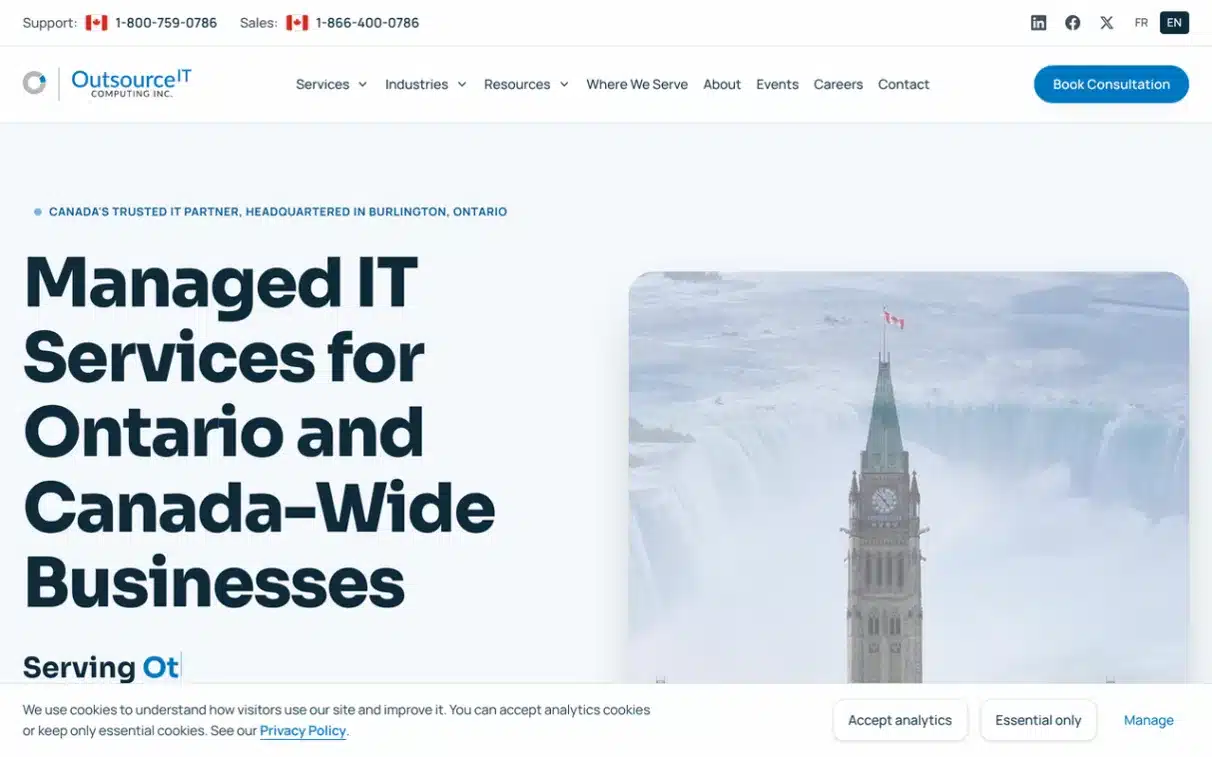
OITC, headquartered in Burlington, publishes the most detailed healthcare compliance documentation on this list. Where others mention PHIPA in a bullet point, OITC explains how the custodian/agent relationship works, which safeguards it puts in place, and what happens when a breach occurs. It also publishes a plain-language explainer on what IPC Decision 284 means for clinics and their IT providers.
OITC documents written agreements that define your practice as the health information custodian and OITC as your agent under PHIPA; unique user accounts with audit logging; encryption in transit and at rest; documented retention and disposal procedures; and breach response that covers evidence preservation, access log production, exposure scoping, and documentation for your privacy officer and the Information and Privacy Commissioner. Data is kept in Canadian Microsoft 365 and Azure regions with Canadian backup repositories, and the location is documented.
EMR coverage names the platforms Ontario practices use: Accuro, OSCAR, PS Suite, AbelMED, PointClickCare, Kroll, and TELUS CHR. OITC supports the infrastructure around them (connectivity, workstations, printing, scanning, integrations) and coordinates with EMR vendors when issues span both sides.
OITC publishes a 15-minute, 24/7 response for critical incidents, imaged spare workstations for fast replacement, and written clinic downtime procedures. Its own published case studies report an 80% drop in IT-related wait times for an Ontario family health team with 45 clinicians, and 99.5% prescription-system uptime for a 6-location pharmacy group. Those are OITC’s reported results, not independent figures. Beyond PHIPA, it covers PCI DSS, HIPAA for cross-border practices, and SOC 2 readiness, with 24/7 SOC monitoring, managed detection and response, and security awareness training for clinical and admin staff.
The gap. OITC mainly serves the GTA and Hamilton area (Burlington, Oakville, Hamilton, Mississauga, Toronto, Brampton, Vaughan, Markham). Practices in Central, Eastern, or Northern Ontario should confirm on-site availability. Pricing isn’t published.
Best for healthcare practices in the GTA and Golden Horseshoe that need the most documented compliance framework and named EMR support, especially multi-location practices and organizations where auditors will look closely at the IT provider relationship.
4. Compudata: More Than 30 Years Serving Southwestern Ontario

Compudata Systems London has served London and southwestern Ontario since 1995. That’s more than 30 years of small and mid-sized business IT support, with healthcare as a named industry alongside legal, education, accounting, and engineering and architecture.
Its healthcare page treats PHIPA and PIPEDA compliance as the starting point and explains how both affect practices and how Compudata builds compliance into daily workflows. It reads as educational content rather than a technical specification, which says something about the audience: practices still getting their arms around compliance, not multi-location organizations running complex EMR environments.
The broader service list includes managed IT, IT security, cloud, backup and disaster recovery, hardware and software services, and business communications. Compudata lists Lenovo, Apple, Microsoft, and Cisco partnerships, and a 24/7/365 help desk with remote and on-site support. Its EMR approach focuses on helping practices move from paper to electronic records, which suits practices early in their digital transition.
The gap. Compudata doesn’t publish healthcare pricing, the EMR platforms it supports, or compliance documentation comparable to OITC’s. For practices in London and southwestern Ontario that need a reliable local MSP with healthcare awareness, that’s often enough. For practices facing formal PHIPA audits, the documentation gap matters.
Best for healthcare practices in London and southwestern Ontario that want an established local MSP with healthcare compliance awareness, particularly practices still digitizing their workflows.
5. Medibyte: Clinic-Focused IT in Eastern Ontario
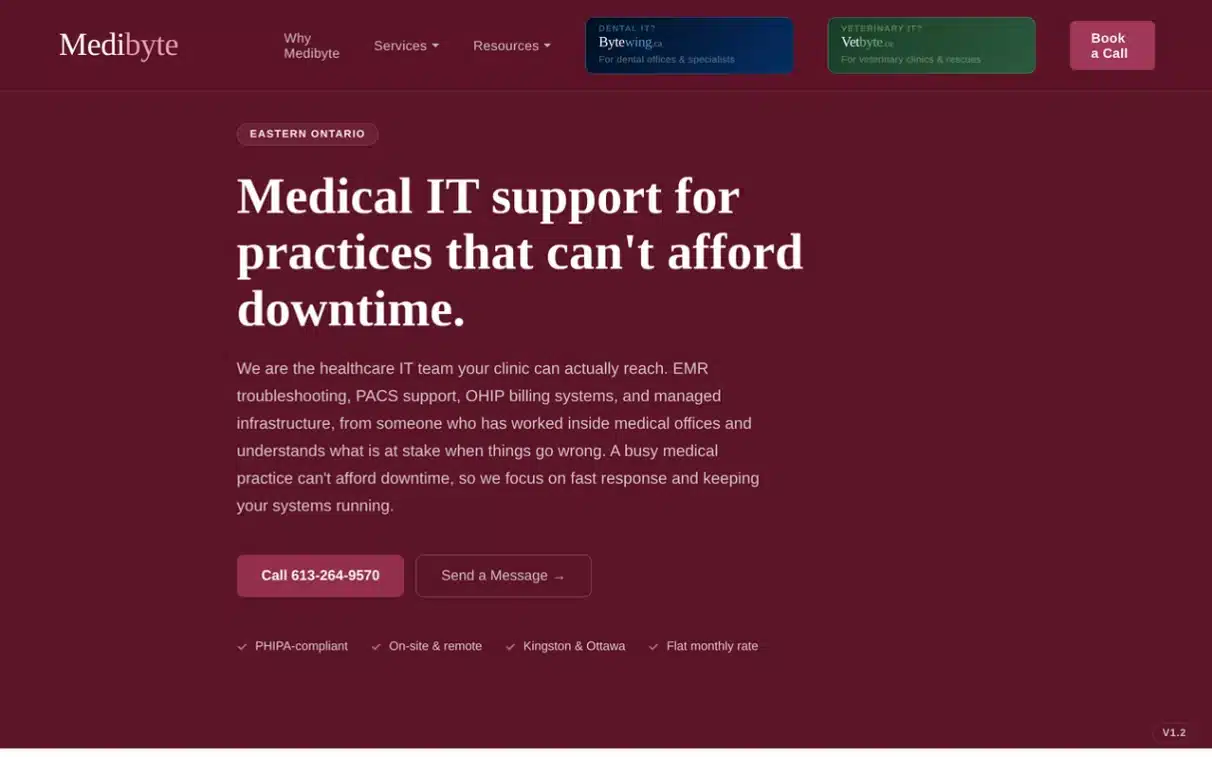
Medibyte takes a different approach from the larger providers here. Based in Perth, it focuses only on clinics across Eastern Ontario, from Kingston to Ottawa, with IT support built around the EMR systems Ontario practices use. Its founder spent years inside medical and healthcare offices working on EMR migrations, PACS deployments, OHIP billing integrations, and clinic networking.
The managed plan covers monitoring of servers, workstations, networks, and backups; unlimited remote helpdesk for clinic staff; on-site visits across Eastern Ontario; patching for Windows, applications, and drivers; daily backup verification with monthly restore tests; MFA, EDR, anti-phishing, and security monitoring; Microsoft 365 administration; and coordination with EMR, imaging, ministry, and ISP vendors.
Onboarding runs in 3 phases: an audit with a written report on the clinic’s setup and gaps, a defined onboarding project to close priority gaps (priced separately), and an ongoing flat monthly rate with quarterly reviews and an annual planning conversation. Medibyte describes its service as EMR-aware and PHIPA-aware, supporting OSCAR (self-hosted and OSCAR Pro), PS Suite, Accuro, Wolf, and TELUS CHR, with same-day remote response. Pricing is a flat monthly rate per device or per user, scaled to clinic size. Hardware, EMR licensing, and clinical software are excluded, and major projects are quoted separately. Dollar amounts aren’t published.
The gap. Medibyte’s coverage is Eastern Ontario only, so practices in the GTA, Central Ontario, or southwestern Ontario need someone else. It’s a small, founder-led operation with little public review data, so ask about team depth and backup coverage when the founder is unavailable.
Best for clinics in Eastern Ontario (Perth, Kingston, Brockville, and the Ottawa area) that want a provider built around clinic workflows, with OSCAR and PS Suite support, flat-rate pricing, and same-day remote response.
What Does Healthcare IT Support Actually Cost in Ontario?
Healthcare IT pricing follows the same models as general managed IT, with a compliance layer that changes what’s in scope.
- Bundled managed IT with healthcare compliance. Cybersecurity, PHIPA-aligned controls, monitoring, helpdesk, and vendor coordination in one monthly fee per user or per device. ACT360 ($65 to $180 per user per month, with most organizations we support landing between $80 and $100 per user) and Medibyte (flat monthly, amount not published) work this way.
- Healthcare-only specialist. The provider’s entire business is healthcare, so compliance and EMR support are part of the core service. BlueBird iT works this way. Pricing isn’t published.
- General MSP with a healthcare practice. The provider serves many industries and applies healthcare-specific safeguards for healthcare clients. OITC (with a deep, documented healthcare practice) and Compudata fall here. Neither publishes pricing.
These models aren’t directly comparable per user because they include different things. A contract that covers IT support, cybersecurity, compliance documentation, and EMR vendor coordination isn’t “more expensive” than a cheaper quote that leaves half of that out. The scope is different.
For scale: a 25-seat clinic at the typical $80 to $100 per user spends roughly $24,000 to $30,000 CAD a year on managed IT. A full-time IT manager typically costs $80,000 to $120,000 a year, and you’d still need cybersecurity and compliance expertise on top. Here’s more on MSP vs in-house IT in Ontario and cyber insurance requirements in Ontario.
Healthcare-Only Specialist or Full-Stack Partner: Which Do You Need?
| What’s driving your search | What kind of question it is | Strongest fit |
|---|---|---|
| You want TELUS Health EMR experience and a provider that works only with clinics | Specialization question | BlueBird iT |
| An auditor or insurer wants documented PHIPA custodian/agent agreements, named safeguards, and breach protocols | Compliance question | OITC |
| You want IT, cybersecurity, compliance, web, and applications from one team that understands the whole practice | Partnership question | ACT360 |
| Your practice is in London or southwestern Ontario and needs a reliable local MSP with healthcare awareness | Geography question | Compudata |
| Your Eastern Ontario clinic needs OSCAR or PS Suite support from a provider built around clinic workflows | EMR and geography question | Medibyte |
There’s no wrong answer among these 5. There’s a right answer for what’s driving your decision.
The Bottom Line
The decision isn’t who ranks highest. It’s which provider fits the pressure behind your search.
If your practice wants one team handling IT, cybersecurity, compliance, and applications, with a partner that understands your operations, ACT360 offers a full partnership and a 90-day exit clause on Managed IT that nobody else on this list publishes. If you want a provider whose entire business is healthcare and who holds the TELUS Health field service relationship, BlueBird iT is built for that. If your auditor wants documented PHIPA custodian/agent agreements with named safeguards, encryption specifications, and breach response protocols, OITC publishes the most detailed compliance framework on this list.
One thing applies whichever provider you choose: your PHIPA obligations as the health information custodian don’t transfer to your IT provider. The provider becomes your agent, under a written agreement, and you stay accountable for what it does with patient data. A provider that doesn’t explain this upfront hasn’t done the work yet. Get an IT Readiness Assessment from ACT360 and compare what we find against whatever the other 4 send back.
ACT360 ranks first on this list, and that’s a disclosed conflict. The limitations stated for each provider, including ACT360, are there so you can check them yourself.
Sources
- Personal Health Information Protection Act, 2004 (Ontario): ontario.ca
- Information and Privacy Commissioner of Ontario: ipc.on.ca
- Office of the Privacy Commissioner of Canada, PIPEDA: priv.gc.ca
- WELL Health, WELLSTAR corporate update on the Microquest and BlueBird iT acquisitions: newswire.ca
- BlueBird iT, About Us: bluebirdinc.com
- OITC, Healthcare and Pharmaceutical: oitc.ca, and PHIPA Decision 284 explainer: oitc.ca/phipa
- OITC Google review count: CloudSecureTech directory listing, updated June 2026: cloudsecuretech.com
- ACT360 90-day exit clause on Managed IT: act360.ca
- Provider websites for BlueBird iT, OITC, Compudata, and Medibyte (November 2026)