A Full-Time CIO Costs a Fortune. A vCIO Gives You the Thinking Without the Salary
Here is the number that sends Ontario businesses looking for a vCIO in the first place. A full-time Chief Information Officer in Toronto runs between $220,590 and $320,220 a year, according to Robert Half. For a business with 20 to 150 people, that salary is impossible to justify, yet the need for senior IT strategy does not go away.
That is the gap a vCIO fills. A virtual CIO gives you executive-level technology planning, a roadmap, vendor negotiation, and budget discipline, on a fraction of a full-time salary, scaled to what you actually need.
The catch is that vCIO has become a label a lot of providers slap on an upsell. Some assign a junior account manager, hand you a templated roadmap, and call it strategy. The difference between a vCIO that moves your business and one that just adds a line to the invoice comes down to two things: who does the thinking, and whether the plan ever gets executed.
That is the lens for this list.
How We Evaluated These Companies
A vCIO is a relationship, not a product, so we looked at the things that decide whether that relationship pays off.
- Who runs your strategy sessions: A vCIO is only worth the fee if a genuinely senior person does the thinking. Ask whether you get a principal or a rotating account manager, because the title on the invoice is not the person in the room.
- Strategy tied to execution: A roadmap that lives in a slide deck changes nothing. The providers that also run the day-to-day IT, or coordinate tightly with whoever does, are the ones whose plans actually ship.
- Business outcomes over ticket counts: A good quarterly review talks about risk, budget, and growth, not how many tickets got closed. If the review is a status report, you hired support, not strategy.
- Budget and vendor discipline: A real vCIO saves you money by managing vendors, optimizing licensing, and stopping spend that does not serve the business. That discipline should pay for a chunk of the fee on its own.
- Fit with your existing IT: Whether you have an internal IT person or none, the vCIO should slot in cleanly, complementing your team rather than competing with it.
The 5 Best vCIO Services in Ontario
1. ACT360 Web & IT: Best for Businesses That Want the Owners Running Strategy, Tied to Execution
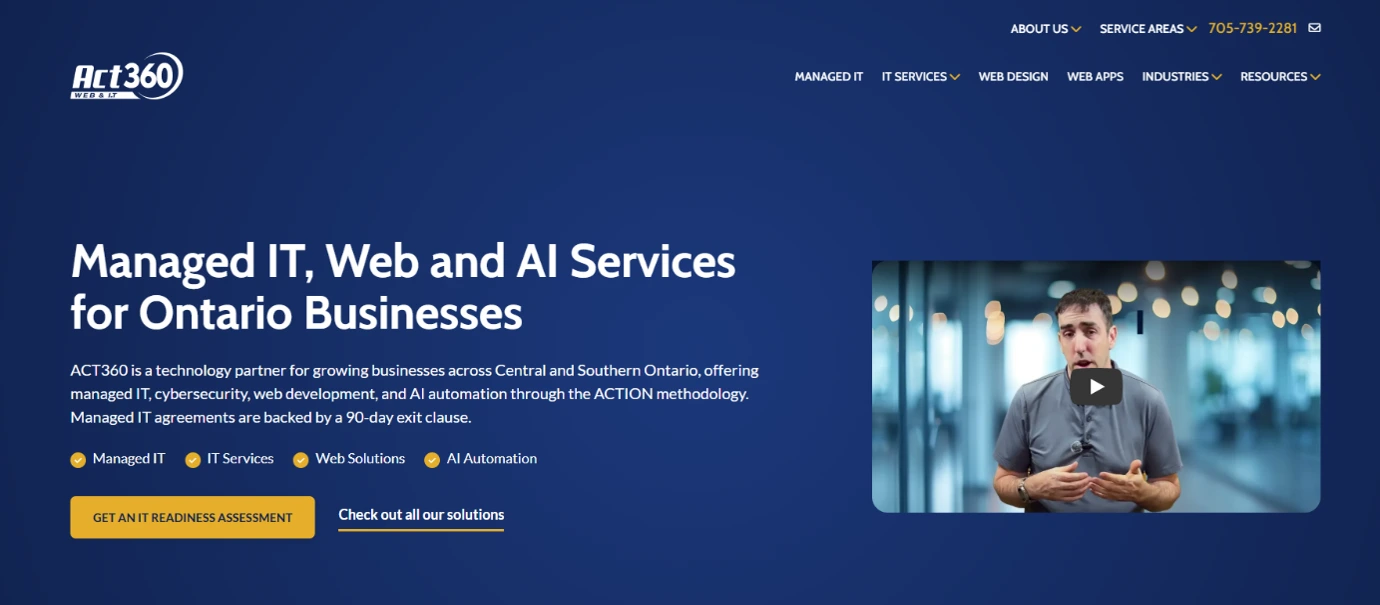
ACT360 is a Barrie-based IT firm serving businesses across Ontario, and its vCIO service is built around a simple promise: the people running your quarterly business reviews are Jeffrey or Adam Bowles, the principals, not a rotating account manager reading from a template. For a 20-to-150-person company, having a principal in the room changes the quality of the conversation.
The deliverables are concrete. Quarterly business reviews covering IT risk, technology budget and vendor review, performance checks, and growth planning. A technology roadmap built from an initial assessment and refined every quarter, not a generic plan. Vendor sourcing and negotiation, technology adoption support for tools like AI, CRM, and ERP, and cybersecurity and compliance planning.
The real edge is that ACT360 runs both the strategy and the day-to-day IT. That means the roadmap does not get handed to a separate team that was not in the room. The same people who set the plan are the ones who execute it, which is the single biggest reason vCIO engagements either work or quietly die. QBRs focus on outcomes, risk, budget, and growth, rather than ticket counts.
On cost, ACT360 is refreshingly direct, naming full-service managed IT at roughly $80 to $150 per user per month as context, and bundling or scoping vCIO work after an assessment rather than selling it off a price list. One honest note: the vCIO page publishes no client outcome metrics, so judge it on the model and the free assessment, not on a stat sheet.
- Best for: Ontario businesses with 20 to 150 employees that want senior, owner-led IT strategy connected directly to the team that executes it.
- Pros: Principals run the QBRs, strategy and execution under one roof, outcome-focused reviews, clear cost context, Microsoft Silver Partner.
- Cons: No published client outcome metrics. Built for SMBs, not large enterprises with an existing CIO office.
- Pricing: Scoped after assessment; often bundled into managed IT. Market context cited at $80 to $150 CAD per user per month for managed IT. Free 30-minute IT Readiness Assessment.
Website: act360.ca/it-services/vcio/
2. Fusion Computing: Best for a Security-Led vCIO
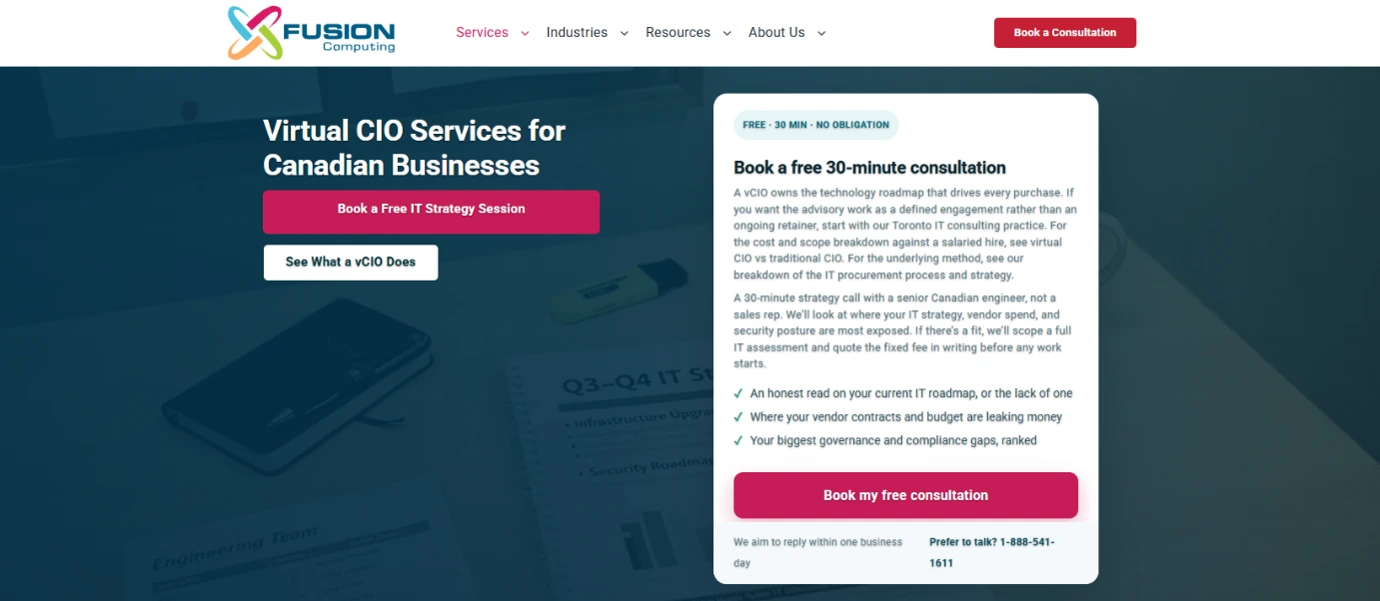
Fusion Computing is a Toronto-headquartered managed service provider that has supported Canadian businesses since 2012, and its vCIO service leads with security. It is CISSP-led and aligns to CIS Controls v8.1, so if your organization treats cyber risk as the first strategic question, the planning starts where you want it to.
As a full MSP, Fusion ties its vCIO strategy to the managed IT and cybersecurity it already delivers, so the roadmap connects to execution. The company cites a 93% first-contact resolution rate and a 4.9 Google rating across its reviews, which speaks to the day-to-day support the strategy sits on top of.
The thing to weigh is emphasis. A security-first lens is a strength for regulated or high-risk organizations, but if your main need is growth planning and budget strategy rather than cyber risk, confirm the engagement balances both.
- Best for: Ontario organizations that want IT strategy led by security, especially in regulated or high-risk sectors.
- Pros: CISSP-led, strong security framework alignment, vCIO tied to full managed IT, solid support metrics.
- Cons: Security-led framing may underweight growth and budget strategy for some businesses.
- Pricing: No public pricing listed; free 30-minute consultation.
Website: fusioncomputing.ca/virtual-cio-services/
3. Outsource IT: Best for a Long-Term, Business-Outcome Partnership
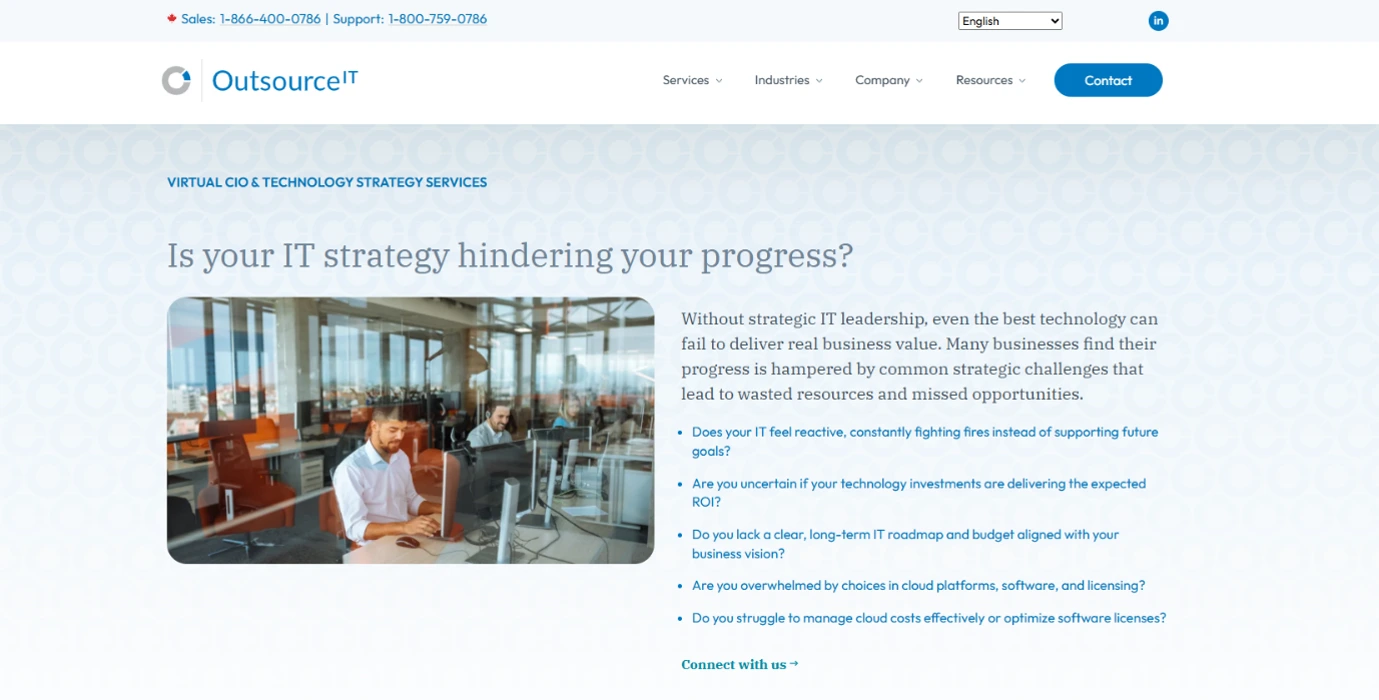
Outsource IT (Outsource IT Computing Inc.) is a Burlington, Ontario MSP whose vCIO service positions the advisor as part of your leadership team rather than an outside consultant. The focus is business outcomes over technical priorities, which is the right orientation for a strategic role.
The deliverables are thorough: a technology strategy and roadmap aligned to business goals, infrastructure assessments, a prioritized technology investment plan, cloud cost management, software license optimization, and implementation oversight. They run a structured three-step process (discovery and assessment, roadmap development, then implementation oversight) and serve a broad range of Ontario industries. A testimonial on their site references an eight-year client relationship, which points to the kind of long-term partnership this role should be.
What to confirm is seniority and cadence. The page is strong on process and outcomes but does not name who runs your sessions or how often, so make that a first-call question.
- Best for: Ontario businesses across industries that want a long-term strategic IT partner embedded in their leadership thinking.
- Pros: Business-outcome focus, thorough deliverables, structured process, evidence of long client tenures.
- Cons: Session seniority and cadence not stated publicly. No published pricing.
- Pricing: No public pricing listed; contact for an assessment.
Website: oitc.ca/services/virtual-cio-technology-consulting/
4. Synergy IT Solutions: Best for a vCIO Bundled With Round-the-Clock Support
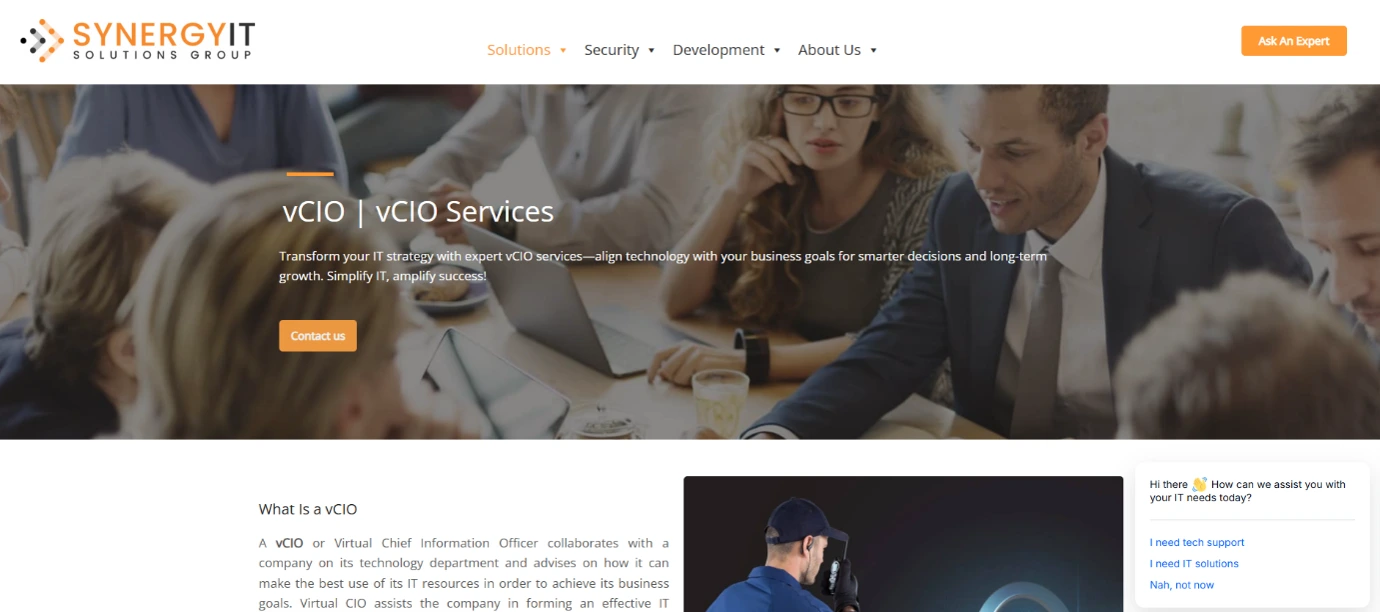
Synergy IT Solutions Group, based in Mississauga with additional offices in Toronto and New York, delivers vCIO as a managed service that includes 24×7 monitoring and support. For an SMB that wants strategy and always-on operations from one provider, that packaging is the draw.
The vCIO deliverables cover a long-term IT roadmap, vendor selection, guidance on adding, replacing, or keeping digital assets, budget allocation advice, and help filling infrastructure gaps for in-house staff. The company cites three decades of industry experience, recognition as one of Canada’s 50 Best Managed IT Companies, and a Business Excellence Consumer Choice Award. The Google reviews praise responsiveness, though those are individual client opinions rather than verified outcomes.
The consideration is that the vCIO sits inside a broader managed-service package, so confirm how much dedicated strategic time you get versus general account management.
- Best for: Ontario SMBs that want IT strategy and 24×7 managed support bundled under one provider.
- Pros: Strategy plus always-on support, long industry track record, external recognition, multi-office reach.
- Cons: vCIO is part of a broader package, so clarify dedicated strategic time. No published pricing.
- Pricing: No public pricing listed; free consultation and cost estimates on request.
Website: synergyit.ca/vcio-services/
5. ITBizTek: Best for Compliance-Heavy Sectors
ITBizTek, headquartered in North York with a second office in Richmond Hill, offers a fractional CIO built around a cybersecurity-first approach and real compliance depth. For a Toronto-area business in a regulated field, that focus is the reason to look here.
The service covers strategic IT planning and a tailored roadmap, IT budgeting and ROI-based prioritization, backup and disaster recovery, a full cybersecurity strategy, and vendor management with a single point of contact. The compliance support is the standout, with named coverage for PIPEDA, HIPAA, and PCI-DSS, including audits, policies, and staff training. Clients typically get monthly strategy sessions, which is a tighter cadence than quarterly-only models.
What to weigh is scale. ITBizTek is built for Toronto-area SMBs, law firms, clinics, accounting practices, and manufacturers, so if you need national or enterprise-scale coverage, confirm the fit.
- Best for: Toronto-area SMBs in regulated sectors that need compliance-grade IT strategy and monthly cadence.
- Pros: Compliance depth (PIPEDA, HIPAA, PCI-DSS), cybersecurity-first, monthly strategy sessions, plain-language communication.
- Cons: Built for the Toronto area and SMB scale. No published pricing.
- Pricing: No public pricing listed; quote and free consultation on request.
Website: itbiztek.com/virtual-cio-services/
At a Glance: How the Five Compare
| Company | Base | Strategic Angle | Typical Client | Pricing |
|---|---|---|---|---|
| ACT360 | Barrie, serves Ontario | Owner-led QBRs, strategy tied to execution | SMBs, 20 to 150 staff | Scoped after assessment / bundled |
| Fusion Computing | Toronto | Security-led vCIO, CISSP | Regulated and high-risk | Not published |
| Outsource IT | Burlington | Business-outcome partnership | Broad industries | Not published |
| Synergy IT Solutions | Mississauga (+ Toronto, NY) | vCIO plus 24×7 support | SMBs | Not published |
| ITBizTek | North York / Richmond Hill | Compliance-first fractional CIO | Regulated Toronto-area SMBs | Not published |
The Real Decision: Is This Strategy, or Is It a Status Report?
Every provider on this list will sell you a vCIO. The question that actually matters is whether what you get back is strategy or a repackaged support report, and two factors decide it.
The first is who sits across the table. A vCIO fee buys senior thinking, so the person running your sessions should be senior. When a principal or a genuinely experienced strategist runs the review, you get judgment, pattern recognition from dozens of other businesses, and a willingness to tell you no. When a junior account manager runs it, you get a template and a polite summary of last quarter’s tickets. Ask by name who will be in the room.
The second is whether the strategy is connected to execution. A roadmap is worthless if it never gets built. Providers that also run your day-to-day IT, like ACT360, Fusion Computing, and Synergy IT, close that gap by design: the people who set the plan also ship it. A standalone strategic advisor can still work well, but you take on the job of making sure the plan actually gets executed by whoever handles your IT.
So the honest filter is this. If you want strategy and execution from one accountable team, choose a provider that does both and insist on a senior person in your reviews. If you already have a strong internal IT team to execute, a pure strategic advisor can slot in, as long as you confirm the seniority and the cadence before you sign.
Questions to Ask Before You Sign
Use these on every provider you shortlist. The answers separate a strategic partner from an upsell.
- Who, by name and seniority, will run my quarterly or monthly strategy sessions, and will it be the same person each time?
- Does your review cover risk, budget, and growth, or is it a report on tickets and uptime?
- Who executes the roadmap, your team or mine, and how do you make sure the plan actually gets built?
- How do you handle vendor negotiation and licensing, and what have you saved clients by doing it?
- How do you work alongside our existing IT person or team without stepping on them?
- What does the first assessment cover, and what will I walk away knowing that I do not know now?
Why Ontario Businesses Choose ACT360 for vCIO
The pitch is not complicated. With ACT360, the owners run your strategy sessions, and the team that sets your roadmap is the team that executes it.
That solves the two failure points in the whole category at once. You are not handed to a junior account manager, because Jeffrey or Adam Bowles run the quarterly reviews directly. And your roadmap does not die in a slide deck, because ACT360 also runs the managed IT, so strategy and execution stay aligned instead of sitting in two different companies pointing at each other.
The reviews focus on what moves the business (IT risk, technology budget, vendor spend, and growth planning) rather than ticket counts. You can see how the vCIO service connects to the day-to-day managed IT services and the broader IT services that keep the roadmap moving.
The starting point is a free, 30-minute IT Readiness Assessment, a no-obligation review of your current setup done by ACT360’s senior team. You can book it through the IT assessment page, and it tells you where your technology actually stands before anyone talks about a roadmap.
The Bottom Line
Ontario has capable vCIO providers, and the five here are all legitimate. The difference is emphasis and model, not whether they can do the work.
If security is your first question, Fusion Computing leads with it. If you want a long-term business-outcome partnership, Outsource IT is built for it. If you want strategy bundled with 24×7 support, Synergy IT fits. If compliance drives your sector, ITBizTek has the depth. And if you want senior, owner-led strategy tied directly to the team that executes it, ACT360 is the call.
Whichever you choose, ask the two questions that matter before you sign: who runs the room, and who builds the plan. A vCIO that gives you a senior strategist and a team that executes is worth every dollar. One that gives you a template and a ticket report is not. Still deciding which model you need? Read fractional CIO vs vCIO vs full-time CIO.
Sources
- Robert Half, Chief Information Officer salary, Toronto (2026): roberthalf.com
- ACT360 vCIO Services: act360.ca/it-services/vcio/
- Fractional CIO vs vCIO vs Full-Time CIO: act360.ca/blog/fractional-cio-vs-vcio/
- Fusion Computing vCIO: fusioncomputing.ca
- Outsource IT vCIO: oitc.ca
- Synergy IT Solutions vCIO: synergyit.ca
- ITBizTek vCIO: itbiztek.com