Ontario Has the Talent. The Hard Part Is Picking the Right Partner
Ontario is a genuine software hub. Toronto ranked third in North America for tech talent in the CBRE 2025 Scoring Tech Talent report, up from fourth the year before, after adding 42,900 tech jobs between 2021 and 2024. There is no shortage of firms that can write code here.
That is exactly why choosing is hard. The field runs from global product consultancies building for Nike and the big banks down to two-person shops working out of a spare room. They do not do the same job, they do not charge the same rates, and they are not interchangeable.
The expensive mistake is hiring the wrong tier. A startup does not need a $250-an-hour enterprise consultancy to build its first product. A bank does not hand its core systems to a freelancer. And a growing business that wants one internal application built does not need an enterprise contract, it needs a partner who will scope the real problem, build it, and hand over the code.
So this list is sorted by fit, not by size. Read the criteria, find your half of the market, then shortlist from there.
How We Evaluated These Companies
Code quality is table stakes. These are the things that actually decide whether a custom software project pays off or becomes an expensive regret.
- Fit for your size and stage: An enterprise firm and an SMB application builder are both legitimate, but only one is right for your project. Hiring up or down a tier is where budgets get burned.
- Code and IP ownership: You should own what you pay for, with the source code, documentation, and credentials handed to you. Ask this before anything else, because the answer separates partners from landlords.
- Discovery before development: The firms that scope the real problem first, and are willing to tell you not to build something, are the ones whose projects ship. The ones that start coding on day one are the ones that miss.
- Integration into your real systems: Software that does not connect to your CRM, your accounting, or your existing tools creates a new silo instead of solving a problem. Confirm the integration plan is part of the build.
- Support and handoff: What happens after launch? Who fixes a bug in month three, and can your own team maintain it? A clean handoff with training beats a dependency you cannot escape.
The 5 Best Custom Software Development Companies in Ontario
1. ACT360 Web & IT: Best for SMBs That Want a Custom Business App Built by the Team Running Their IT
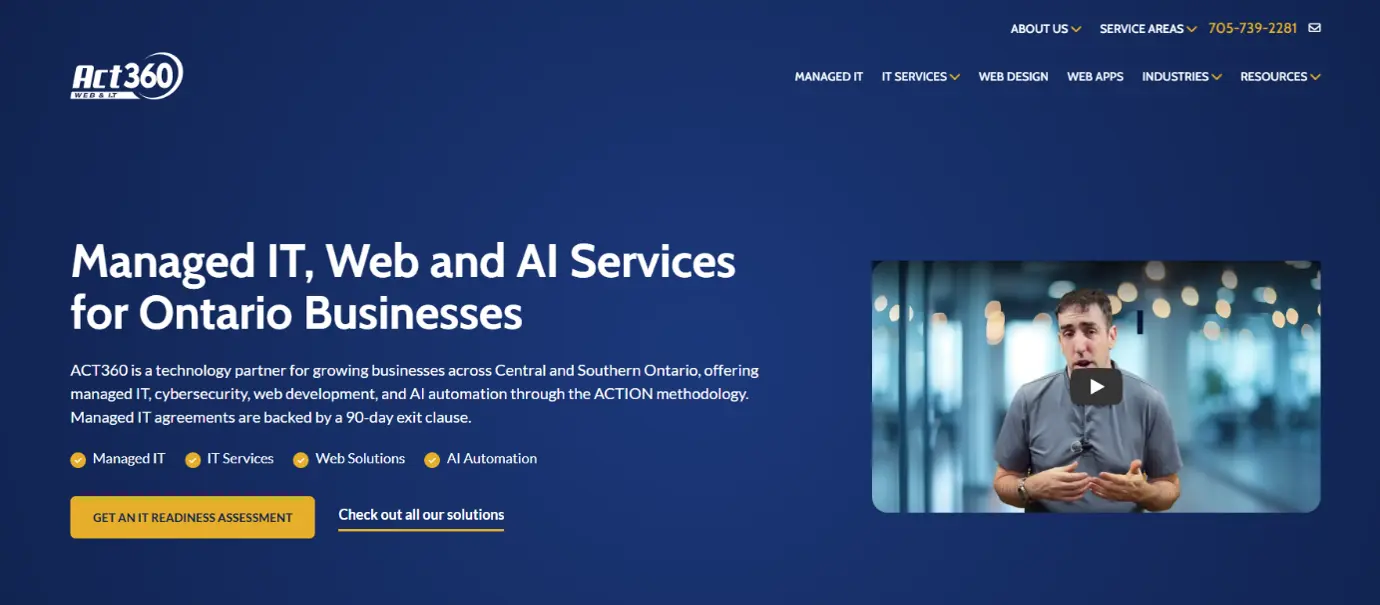
ACT360 is a Barrie-based web and IT firm serving businesses across Ontario. It is not an enterprise software house, and it does not pretend to be. What it does is build custom web and business applications for small and mid-sized companies, then run and support them as part of a broader IT relationship. For an SMB, that combination is rare and useful.
The build list is practical and real: client portals, booking systems, e-commerce and payment flows, API integrations with CRMs and Google tools, and custom search. The case studies are concrete, a field service inventory app for a construction company, a QR code workflow system, a client portal for support tickets, a Power BI dashboard embedded for a healthcare provider, and a secure patient file upload. They build on React, Laravel, Node, WordPress, and Drupal, and they pick the stack to fit the job rather than forcing one framework on every client.
Two things set ACT360 apart for the SMB buyer. First, you own the application, with handoff, training, and no vendor lock-in stated plainly. Second, the same team that builds the app also manages the infrastructure it runs on, so there is no gap between the developer who shipped it and the IT team who has to keep it alive. Their A.C.T.I.O.N. method handles rollout in phases, not a big-bang cutover, with quarterly reviews.
The honest limit: ACT360 is the right call for SMB business applications, not for enterprise-scale core systems or consumer apps with millions of users. If that is your project, look further down this list.
- Best for: Ontario SMBs that want a custom business application built, integrated, and supported by the same team that runs their IT, with full code ownership.
- Pros: You own the code, no vendor lock-in, IT-integrated support, phased rollout, pragmatic stack choices, real SMB case studies.
- Cons: Built for SMB applications, not enterprise core systems or large-scale consumer apps. No native mobile app development.
- Pricing: No public pricing. Projects are scoped by users, logins, integrations, and payments after a free assessment.
Website: act360.ca/web-apps/
2. Modall: Best for Startups and Scale-Ups Building an MVP or SaaS Product
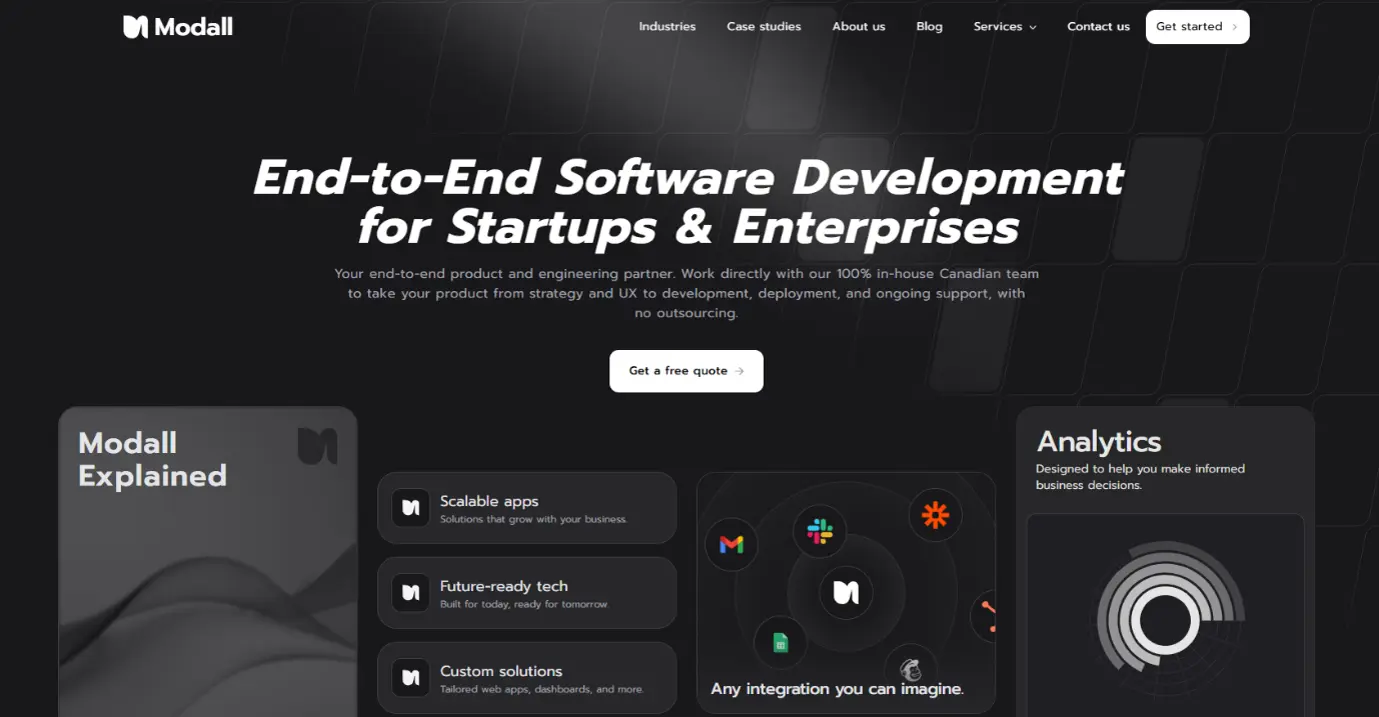
Modall is based in the Uxbridge and Toronto area and builds software entirely in-house on a full-stack TypeScript foundation, with React Native for mobile. The focus is new products: MVPs, SaaS platforms, and early-stage builds where a founder needs to get something real in front of users fast.
The in-house claim matters more than it sounds. A lot of agencies win the pitch and then subcontract the actual work offshore, which is where quality and communication break down. Modall says it keeps the whole team in-house, which for a startup managing burn and timelines is a meaningful difference. Their published niche work includes social networking and travel apps.
The trade-off is scope. Modall is a boutique, so it is built for focused product work, not sprawling enterprise programs across dozens of systems.
- Best for: Founders and scale-ups building an MVP or a SaaS product who want an in-house team and a fast path to launch.
- Pros: 100% in-house build, modern full-stack TypeScript, React Native mobile, startup and product focus.
- Cons: Boutique scale. Not built for enterprise-wide programs or heavily regulated core systems.
- Pricing: Mid-tier. Industry MVP builds commonly start around $40,000 and scale with complexity. Confirm scope in a discovery call.
Website: modall.ca
3. Rangle.io: Best for Enterprise Digital Products and AI Features at Scale
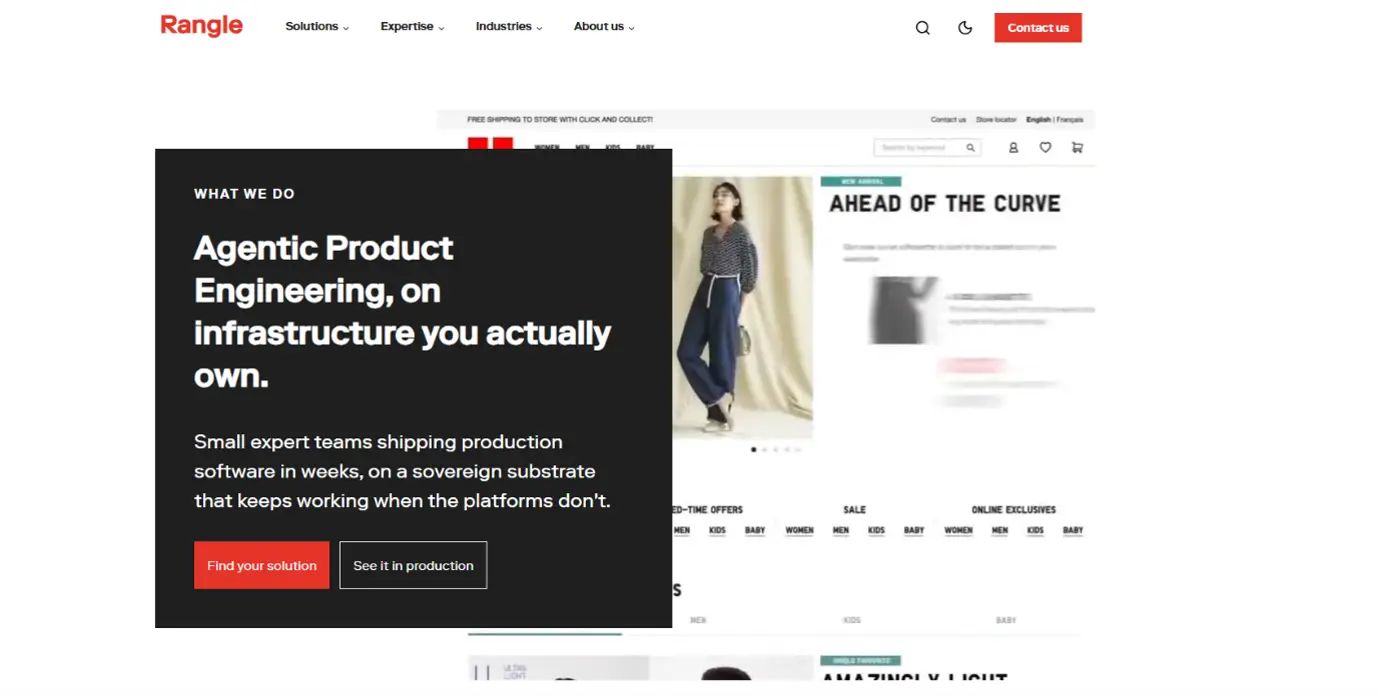
Rangle is a Toronto product engineering firm that builds for large brands and regulated industries. The client list is the resume here: Nike, Stripe, Google, Sanofi, Staples, and The North Face, among others. If your project is a serious digital product with real scale and compliance demands, Rangle plays at that level.
Their strengths are modern front-end and composable architecture (React, headless CMS platforms like Contentful and Sanity, Shopify), shipping AI features into production, design systems, and migrations off legacy platforms like Sitecore and AEM. They lean into audit-ready delivery with encryption and audit trails, and reference EU AI Act alignment, which signals they are built for regulated markets.
The caveat is exactly what makes them strong. This is enterprise-tier work at enterprise-tier pricing. A small business with a single internal app to build will find Rangle overbuilt and overpriced for the job. Their own productivity and ROI figures are company claims and forward-looking projections, so treat those as marketing, not guarantees.
- Best for: Enterprises and funded companies building scaled digital products, AI features, or migrating off legacy platforms.
- Pros: Enterprise and regulated-industry depth, strong AI-in-production and headless architecture, blue-chip client track record.
- Cons: Premium pricing. Overbuilt for small-business or single-application projects.
- Pricing: Premium, enterprise tier (commonly $250+/hour at this level). Monthly retainers available. Quote on consultation.
Website: rangle.io
4. The Jonah Group: Best for Fintech, Capital Markets, and Complex Backend Systems
The Jonah Group is a Toronto firm that has spent over two decades building high-performance custom software, with a clear center of gravity in financial services. Their client list reads like a who’s who of Canadian finance: BMO, CIBC, TMX, H&R Block, Farm Credit Canada, and CAA among them.
Where they stand out is complex, high-stakes backend work, big data, machine learning, business intelligence, and the kind of transaction systems that cannot go down. Their proprietary LightWave development process has been refined over 22 years, and they make a notable claim: no failed projects since 2001, with every project they started reaching production. That track record, if it holds, is rare in this industry.
This is specialist enterprise work. If you are a fintech, a financial institution, or a company with genuinely complex data and transaction requirements, they are a serious candidate. If you need a simple business app, this is more firm than the job requires.
- Best for: Financial institutions, fintechs, and enterprises with complex, high-reliability backend and data systems.
- Pros: Deep fintech and capital markets expertise, strong reliability track record, mature 22-year delivery process.
- Cons: Enterprise specialist. Oversized and overpriced for simple business applications.
- Pricing: Premium, enterprise tier. Quote on consultation.
Website: jonahgroup.com
5. TribalScale: Best for AI Engineering, Mobile, and Emerging Technology
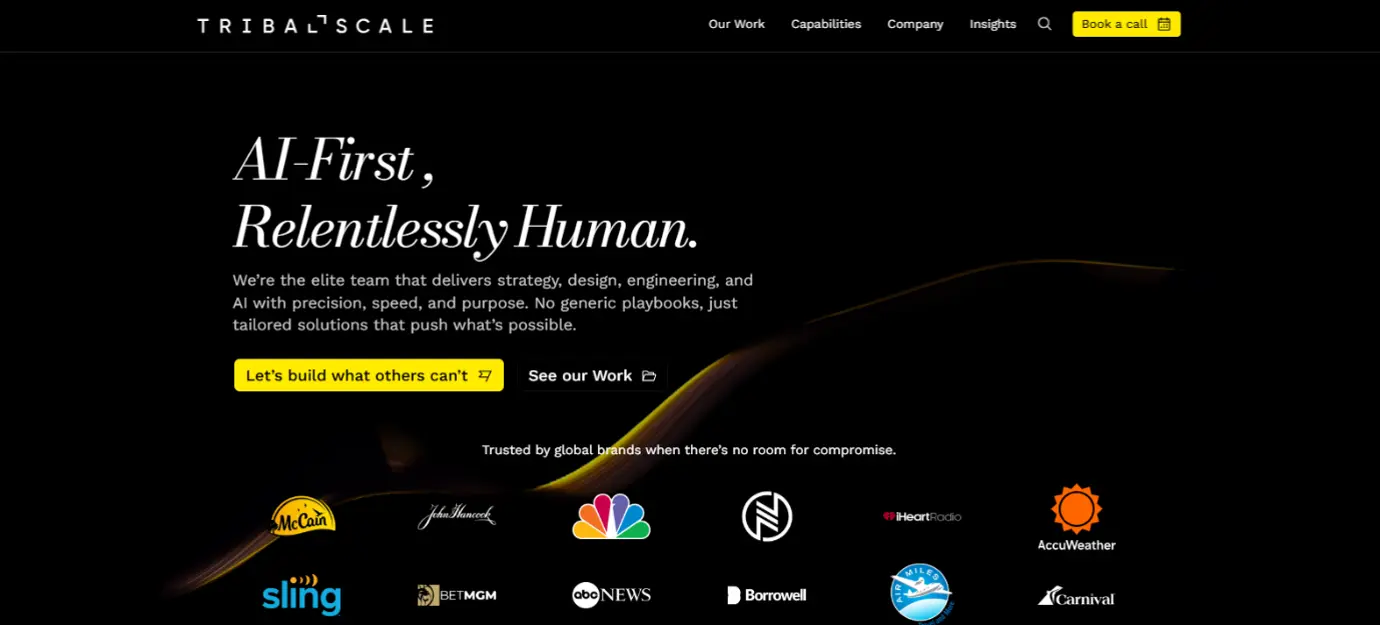
TribalScale is a Toronto-headquartered innovation firm, with offices in New York and Miami, that pairs AI-powered engineering with human-centered design. It claims 700+ products launched and a 95% repeat client rate, and it runs a venture studio alongside its client services, so it works with both enterprises and startups.
The current focus is AI and data: AI and LLM solutions, AI agent development, and Databricks work, sitting alongside established strengths in mobile and web applications, product strategy, and design. For a company that wants to build something AI-first or push into mobile and emerging tech with an experienced partner, TribalScale fits.
The breadth is the thing to watch. A firm that spans AI, mobile, design, transformation, and a venture studio is capable, but you want to confirm the specific team and experience assigned to your project, not just the company-wide resume.
- Best for: Companies building AI-first products, mobile apps, or pushing into emerging technology with an experienced partner.
- Pros: Strong AI and mobile depth, large launch record, high repeat-client rate, works with both enterprises and startups.
- Cons: Broad service range, so confirm the specific team on your project. Enterprise-tier pricing for enterprise work.
- Pricing: Premium tier, with staff augmentation and venture options. Quote on consultation.
Website: tribalscale.com
At a Glance: How the Five Compare
| Company | Base | Best At | Typical Client | Pricing Signal |
|---|---|---|---|---|
| ACT360 | Barrie, serves Ontario | Custom business apps, IT-integrated, code ownership | SMBs | Not published (free assessment) |
| Modall | Uxbridge / Toronto | MVPs, SaaS, React Native mobile, in-house | Startups and scale-ups | Mid-tier |
| Rangle.io | Toronto | Enterprise products, AI in production, headless | Large brands, regulated | Premium |
| The Jonah Group | Toronto | Fintech, capital markets, complex backend | Financial, enterprise | Premium |
| TribalScale | Toronto (+ NY, Miami) | AI engineering, mobile, emerging tech | Enterprise and startups | Premium |
The Real Decision: An Enterprise Software House or an SMB Application Partner?
This is the question that sorts the whole list, and it is the one worth getting right before you call anyone.
An enterprise software house builds large, complex systems for organizations with the budget and internal teams to match. Rangle.io, The Jonah Group, and TribalScale live here. You hire them for scale, specialized expertise, and work where the stakes and the compliance requirements are high. You pay premium rates, and for the right project, the rates are justified.
An SMB application partner builds the specific application your business needs and fits it into the systems you already run. ACT360 lives here, and Modall sits close for product-stage startups. You hire this tier for a focused build, a fair price, code you own, and a team that will still take your call after launch.
The mistake runs both directions. A small business that hires an enterprise consultancy for a single internal app pays for capability it will never use. An enterprise that hands a mission-critical system to a boutique can outgrow the partner mid-project. Neither firm did anything wrong. The buyer picked the wrong tier.
So before you compare portfolios, answer two questions honestly. How complex and large-scale is this system, really? And do you have an internal team to own it, or do you need a partner to build it and keep it running? Those two answers point you at your half of this list faster than any sales call will.
Questions to Ask Before You Sign
Use these on every firm you shortlist, whichever tier you land in. The answers tell you more than the portfolio.
- Do we own the source code, documentation, and credentials outright when the project ends, with no licensing strings?
- Who actually writes the code, your in-house team or a subcontractor, and will I meet them before I sign?
- How do you run discovery, and are you willing to tell me not to build something if it does not make sense?
- How will this integrate with the systems we already use, and is that integration in the scope and the price?
- What does support look like after launch, and can our own team maintain this without you?
- What is the smallest first phase that proves the approach before we commit to the full build?
Why Ontario SMBs Work With ACT360 for Custom Applications
The pitch is not that ACT360 out-engineers the enterprise houses. It does not, and it does not try to. The pitch is that for an Ontario SMB building a business application, ACT360 removes the two biggest risks in the whole category.
The first risk is the handoff gap. With a pure development agency, the team that builds your app disappears after launch, and your IT people inherit something they never touched. With ACT360, the team that builds the application is the same team that runs your infrastructure, so there is no handoff and no finger-pointing when something needs a fix.
The second risk is lock-in. ACT360 states plainly that you own the application, with full handoff and training. You can see the kind of work this produces in their case studies, and how the application layer connects to the broader IT services that keep it running.
The starting point is a free assessment, where ACT360 scopes the real problem before quoting a build. You can explore the custom web application services to see the range, from client portals and booking systems to field service tools and API integrations.
The Bottom Line
Ontario has excellent custom software firms, and the five here are all legitimate. The difference is not quality. It is fit.
If you are building an enterprise-scale system, a regulated financial platform, or an AI-first product, Rangle.io, The Jonah Group, and TribalScale are the tier you want, and the premium is the cost of that capability. If you are a startup chasing an MVP, Modall gives you an in-house team and speed. And if you are an Ontario SMB that needs a custom business application built, integrated with your systems, and supported by a team that will not vanish after launch, ACT360 is the call, with code you own at the end of it.
Whichever tier fits, ask the ownership question first. A firm that gives you the code and a clean handoff is a partner. One that keeps you locked in is a landlord. You can tell which is which before you sign a thing. Not sure you need custom software at all? Start with custom web applications vs. off-the-shelf software: how to decide.
Sources
- CBRE 2025 Scoring Tech Talent, Toronto ranking (reported Sept 2025): renx.ca
- Toronto ranks third in North America for tech talent, CTV News: ctvnews.ca
- ACT360 Web Apps: act360.ca/web-apps/
- Custom Web Applications vs. Off-the-Shelf Software: act360.ca/blog/custom-web-apps-vs-off-the-shelf-software/
- Modall: modall.ca
- Rangle.io: rangle.io
- The Jonah Group: jonahgroup.com
- TribalScale: tribalscale.com